Home · Guides · Gathering & Logistics
Gathering, Caravans & Expeditions
Quick answers
- Is Iron Realms free to play?
- Yes. Iron Realms is free to play in any browser with no download and no account required. Every building, troop tier and Seat of Power is reachable without spending money — purchases buy speed and cosmetics, never a higher ceiling.
- Does spending money make you stronger in Iron Realms?
- No. Nothing purchasable raises your power ceiling. A charter audit runs on every build and fails it if any offer would sell power. During the pre-alpha nothing is for sale at all — better than that, the store gives its goods away: everything in it is free to take, once a day per item, while the realm is being built. When payments do open, spending will compress time only: it clears timers, it never raises the summit.
- How do you get to Essos in Iron Realms?
- Build a Harbour, which unlocks as a city plot at Keep level 10, and lay down ships at the Harbour itself — its panel is the shipyard, and it berths 10 keels per level. What may cross is the smaller of two numbers: the berths your harbour can launch (800 per harbour level) and the berths your hulls can hold. Until a harbour stands, a gathering party sent at an eastern vein is refused — marches are overland, and there is no route east without one.
- How long does it take to max a keep in Iron Realms?
- Keeps cap at level 45 and troops at tier 13 — the same summit for everyone, and it is a campaign: about seven months of steady play at half an hour a day, counting keep 45 and the nineteen plots that gate it. The Fair Play ledger inside the game reads that figure straight out of the shipped constants, so it is never a month behind the build.
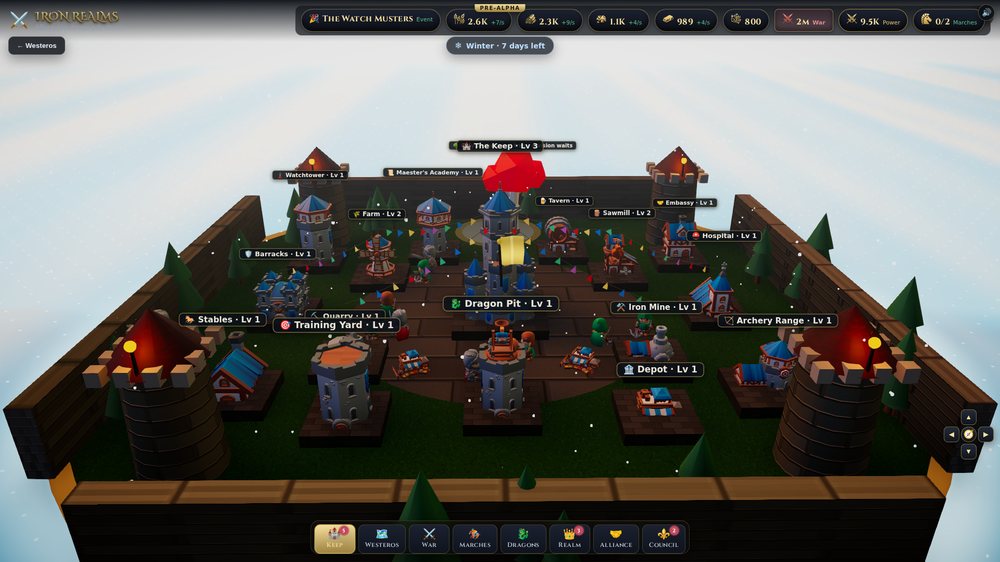
War is loud, but it is resources that win. Iron Realms runs a whole quiet economy that pays while you sleep — gathering parties in the field, a caravan for every day of the week, and timed maester expeditions. Master it and you will always afford the next upgrade.
Gathering parties
Send troops to a resource node and they harvest over time, then march home laden. It costs no energy and risks little — the steady backbone of your income. Bring a commander with a gathering skill to haul more, faster.
The rate is 2,500 per hour per level of node richness before any modifier, so a richness-5 node pays 12,500 an hour. Read that against the expedition table below: field gathering now comfortably out-earns even the best expedition, which is a reversal of how this guide used to read. Gather in the field while you are here; send expeditions for the hours you are not. The surface rate is deliberately unchanged by the realm's speed: a surface trip is mostly marching, and marches already run three times faster, so surface gathering keeps pace through the road rather than through the node.
The party you send is sized to the task, not your whole army: it is the fewest troops that haul exactly what the biggest march your Training Yard allows would haul, so a rich node no longer strands your entire host at a berry patch. The rest of your garrison stays home — free to gather elsewhere, stand watch, or answer an attack — and the Gathering drawer shows exactly how many troops ride ("🎒 Sends N of M") before you send them. Field marches and gathering parties now share one pool of march slots (it grows with your Keep and council), so several errands can be out at once instead of the first one eating every slot.
Deep workings — the late-game, all-day gather
Four deep workings — one vein per resource, marked ⛏️ in the Gathering drawer — work on the opposite clock from every surface node. A surface party computes its haul at launch and loads the carts in seconds; at a deep vein your host stays, in real time, until the carts are full or a long working day (up to 14 hours) is spent, whichever comes first. The vein pays eighteen times the surface rate, so a late-game army's day at a deep working comes home with a seven-figure haul — roughly one big upgrade's worth — and each vein refills at dawn. A deep working also brings its own cart train, hauling three times what the same host could carry off a field, because the vein's stock, its rate and the wagon all scale together with the realm's speed. That is why the trip is still an all-day commitment rather than a short errand: if the rate had risen alone, the carts would simply have filled sooner and the working day would have shrunk.
The price is the day itself: a deep working still sends a big host, because matching a full day's yield takes real numbers — but it is sized to that yield, capped at your Training Yard's march ceiling, never your entire home army. Whatever it takes rides for the day and your walls stand thinner while it works, but the rest of your garrison stays home rather than marching along for no reason. The card shows exactly what your current host would spend and haul before you send it — an all-day commitment is chosen with open eyes, never discovered after the army has marched. A young realm's whole army may still fall short of the Training-Yard ceiling; the same sizing logic applies to it, so a lean early host simply fills its wagons and comes home early. The deep clock only grows as long as it takes the sent party to fill its carts, capped at 14 hours.
The harbour, and the veins across the sea
Four more deep workings sit on the eastern continent, and they are the richest ground in the game — a far larger stock than their western counterparts, paying a bonus on top of the deep rate. They are also unreachable on foot. A march is overland, so a party sent at an Essos vein without a crossing is simply refused, and told why.
What opens the route is the Harbour, a city plot that appears once your Keep reaches level 10. It is the seventeenth work of your city and the only one that is not about your city at all: its level is the crossing. Each harbour level puts 800 more troops on the water.
The harbour is only half of it. What may actually sail is the smaller of two numbers — the berths your harbour can launch, and the berths your hulls can hold. A great fleet at a small harbour is as stuck as a great harbour with no fleet, and the two are built on different clocks: the harbour is an ordinary building on the ordinary upgrade curve, while hulls are laid down from timber and iron at the Harbour itself — its panel is the shipyard, and it berths 10 keels per level. When a crossing is refused, the refusal names which of the four is short — harbour, hulls, a fleet still out reaving, then berths, in that order — so there is never a guess about what to build next.
Plan the crossing the way you plan a deep working, and then some: the party is sized to the task like any other gather, then trimmed to what your harbour's berths and your hulls can carry — the carriers board first, the rest stand at home, and the card says “trimmed to your berths” when the decks were the dial that bound, so you know it was the fleet and not the Training Yard. A composed host sent east is trimmed the same way rather than refused; only a host that cannot sail at all — no harbour, no hulls, a fleet still out — is turned away. The vein is further away than anything in Westeros, and your walls stand thin for the whole voyage out, the working day, and the voyage home.
Maester expeditions — the away-time engine
Three timed missions, and the arithmetic strongly favours the long one:
| Expedition | Time | Returns | Per hour |
|---|---|---|---|
| The Nearby Holdfast | 10 min | 400 food, 300 wood, 200 stone, 150 iron | ~6,300 |
| The River Market | 40 min | 1,600 food, 1,200 wood, 900 stone, 700 iron | ~6,600 |
| The Old Ruins | 2 h 40 m | 7,000 food, 5,500 wood, 4,200 stone, 3,200 iron | ~7,500 |
These are the paced times — the realm runs at triple speed, so the missions the module prices at thirty minutes, two hours and eight take a third of that, and the haul is unchanged, which is what triples the hourly rate. The Old Ruins pays about 20% more per hour than the short run and needs no attention for over two and a half hours. But note the ceiling: ~2,500 an hour is what a single richness-1 node pays a gathering party, so expeditions are not an income strategy — they are an away-time strategy, which is exactly what they are good at. Send the Ruins when you log off overnight; save the 30-minute Holdfast for when you know you will be back soon. And if you are at the keep, your marches earn far more in the field than waiting on a maester. Recall is free if you need the commander back — only the haul is forfeit.
Weekly caravans
A different caravan opens on the map every day of the week, and they are not equal:
| Day | Caravan | Richness | Valyrian steel |
|---|---|---|---|
| Sunday | The Riverlands Convoy | 4 | 1 / 1,000 |
| Monday | The Stormlands Wagons | 4 | 1 / 1,000 |
| Tuesday | The Westerlands Bullion Train | 5 | 2 / 1,000 |
| Wednesday | The Reach Harvest Train | 4 | 1 / 1,000 |
| Thursday | The Vale Mountain Train | 4 | 1 / 1,000 |
| Friday | The Dornish Spice-and-Steel Road | 5 | 2 / 1,000 |
| Saturday | The Kingsroad Northbound | 4 | 1 / 1,000 |
Tuesday and Friday are the days that matter. Both run at richness 5 and, more importantly, pay double Valyrian steel — and Valyrian steel is the gate on masterwork and Valyrian gear, which no amount of ordinary resource solves. If you only clear two caravans a week, clear those two.
Stack every multiplier
Gathering compounds with buildings, research, season modifiers, world events (Harvest Festival is +25%), godswood blessings (+12%) and VIP (+22.5% at 15). For the full stack, read Maximizing Resources.